Alcohol Testing After an Accident: The 2-Hour Rule and Why Every Minute Counts
July 6, 2026 · RC Team
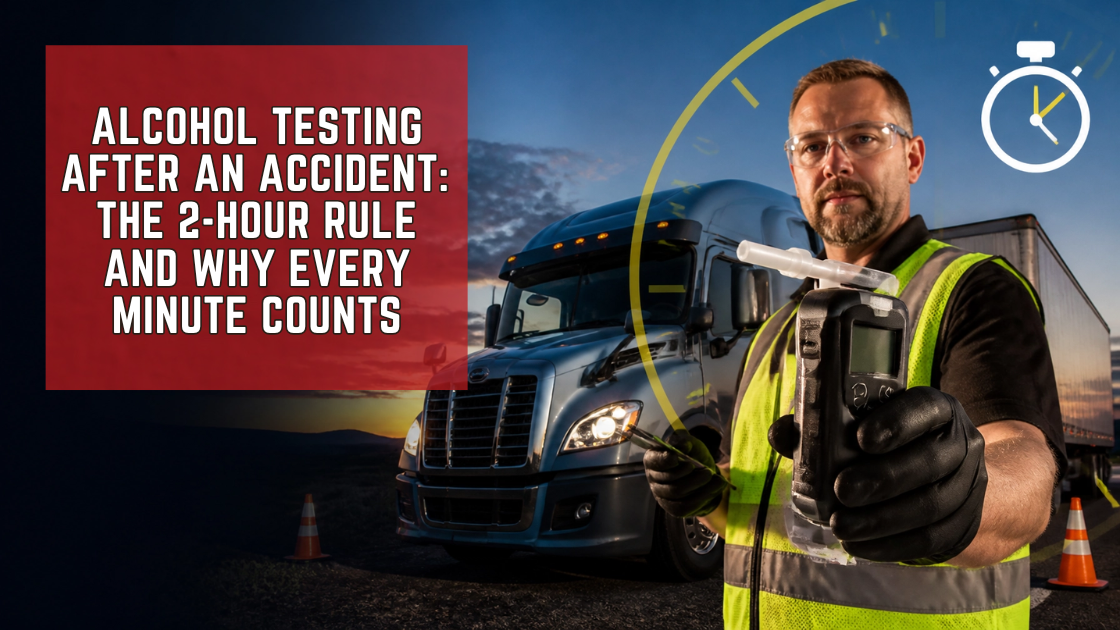
When a qualifying commercial motor vehicle accident occurs, your response plan must move quickly from scene safety to compliance. Under 49 CFR § 382.303, an employer must arrange required post-accident alcohol testing as soon as practicable, with the first two hours serving as the critical target. If the test is not completed within two hours, you must document the reason for the delay and continue making reasonable efforts until the eight-hour limit.
The reason for this short window is practical as well as regulatory: alcohol leaves the body relatively quickly through metabolism. As time passes, the driver’s alcohol concentration can change, which means a test taken hours later may not represent the driver’s condition as closely as a test completed promptly after the event. That’s why sending a driver across town to a distant clinic can create a preventable compliance problem.
WHEN IS POST-ACCIDENT ALCOHOL TESTING REQUIRED?
Post-accident testing is not automatically required after every minor collision. For an FMCSA-regulated driver, alcohol testing generally applies when the accident involves a fatality, or when the driver receives a citation for a moving traffic violation arising from the accident and the accident involves qualifying bodily injury or disabling damage requiring a tow-away.
Under the federal rule, alcohol testing is required in these situations:
A fatality occurs, whether or not the driver receives a citation.
A person suffers bodily injury and receives immediate medical treatment away from the scene, and the driver receives a qualifying moving-violation citation.
A motor vehicle sustains disabling damage requiring transportation from the scene by tow truck or another motor vehicle, and the driver receives a qualifying moving-violation citation.
The driver was performing safety-sensitive functions at the time of a fatal accident.
The regulation also makes clear that emergency care takes priority. You should never delay necessary medical attention, interfere with law enforcement, or prevent a driver from obtaining emergency assistance simply to complete a test. However, once the immediate emergency has been addressed, your company should act without unnecessary delay.
THE 2-HOUR RULE: A DOCUMENTATION CHECKPOINT
The two-hour mark is often described as a deadline, but it is more accurately a documentation checkpoint within the larger eight-hour testing window. If a required alcohol test is not administered within two hours after the accident, the employer must prepare and maintain a record explaining why the test was not promptly administered. You must still continue attempting to arrange the test.
Acceptable reasons for delay may include emergency medical treatment, law-enforcement restrictions, unsafe scene conditions, extreme remoteness, or the unavailability of an appropriate testing professional. The important point is that the reason should be specific, factual, and connected to the actual response timeline. A vague note such as “clinic unavailable” may not show the reasonable effort that regulators expect.
Your response team should record:
The accident date, time, and precise location.
When the company was notified.
When the testing provider was contacted.
The steps taken to locate a qualified collector.
Any medical, law-enforcement, weather, or scene-safety restrictions.
The collector’s dispatch time, arrival time, and collection completion time.
Any reason the driver could not remain readily available.
> Quick Tip: Treat the two-hour point as an escalation trigger. If a collector has not arrived or a clinic plan is uncertain, document the reason immediately and activate a mobile response instead of waiting for the window to disappear.
WHY ALCOHOL METABOLISM MAKES EVERY MINUTE MATTER
Alcohol does not remain at a fixed concentration in the body after consumption. The body begins processing alcohol through metabolism, and the amount present in a person’s system can decline as time passes. Individual results vary based on factors such as consumption pattern, body composition, food intake, and other physiological conditions, so employers should not try to estimate impairment or calculate a driver’s alcohol level themselves.
The compliance concern is simple: a delayed test gives you less timely information about the driver’s alcohol status near the accident. A prompt test provides a more useful record of the driver’s condition during the period immediately following the event. It also demonstrates that your company responded seriously and promptly to a safety-sensitive incident.
The eight-hour limit exists because the value and practicality of a post-accident alcohol test diminish as time passes. If the test has not been administered within eight hours, the employer must stop attempts to administer it and document why it was not completed. Those records must be maintained and submitted to FMCSA upon request.
BAT VERSUS SALIVA: WHAT IS THE DIFFERENCE?
A breath alcohol test measures alcohol in a person’s breath using an approved testing device. In DOT terminology, a Breath Alcohol Technician, or BAT, is the trained person who conducts breath alcohol testing using an approved evidential breath testing device. In everyday fleet conversations, “BAT” may refer to the test, the technician, or the overall breath-testing process, but technically it describes the qualified technician.
A saliva alcohol screening uses an approved alcohol screening device to analyze a saliva specimen. It can be useful when a qualified collector is responding at a roadside, yard, terminal, or other location where speed and portability matter. If a screening result requires confirmation, the applicable DOT procedures must be followed, including the required confirmation process using an approved breath-testing device and qualified technician.
The correct method depends on the applicable DOT requirements, the equipment available, and the qualifications of the person conducting the test. Your company should not substitute an informal breath check, consumer-grade device, or noncompliant process for a DOT alcohol test. A mobile collection provider can help coordinate the appropriate testing procedure while preserving the timing and documentation needed for your records.
WHY THE TEST SHOULD HAPPEN AT THE SCENE OR AS CLOSE AS POSSIBLE
The regulation requires testing as soon as practicable; it does not mean that every test must literally occur in the roadway. Still, the closer the collector can get to the driver, the less time your company loses to transportation, traffic, parking, check-in, and clinic wait times. A driver who must travel 45 minutes to a facility may spend another hour waiting before the collection even begins.
That travel model is especially risky when an accident occurs overnight, on a weekend, in a rural area, or far from a clinic with DOT-qualified personnel. It can also create confusion about where the driver is located, whether the driver remains available, and who is responsible for coordinating the next step. The thing is, a clinic may be perfectly capable of testing but still be the wrong operational choice when the clock is already running.
A roadside or onsite collection can reduce those delays by bringing the qualified professional to the driver. The collector can meet the driver at a safe location, carrier terminal, repair facility, staging area, or other appropriate site while the company manages the accident response around the collection.
HOW READI COLLECT HELPS PROTECT THE TESTING WINDOW
READI Collect is designed for time-sensitive drug and alcohol testing when sending a driver to a fixed facility is impractical. Through its patented mobile app, your team can request an onsite collection and connect with a nationwide network of more than 3,000 certified collectors. READI Collect operates 24/7/365, helping you initiate a response when accidents occur outside ordinary business hours.
The platform supports a faster, more transparent response by providing:
On-demand mobile collector dispatch.
Coverage for roadside, terminal, yard, and other onsite locations.
Real-time event status and communication.
Location and time-stamp reporting.
Detailed collection records for compliance files.
A company portal for reviewing events and reports.
Support for post-accident and other time-sensitive testing needs.
READI Collect’s approach also helps reduce the administrative burden on fleet managers. Instead of searching for an open clinic, calling multiple facilities, and trying to coordinate a driver’s transportation, you can initiate one mobile request and track the response. That does not eliminate your responsibility to determine whether testing is required, but it gives you a convenient and practical way to act once the decision is made.
A PRACTICAL POST-ACCIDENT RESPONSE CHECKLIST
Your written procedure should give dispatchers, safety managers, and drivers clear instructions before an accident occurs. A response checklist can help your team avoid confusion during the first few minutes, when decisions and documentation matter most.
Use the following process as a starting point:
Protect life and safety first. Contact emergency services and follow law-enforcement instructions.
Record the accident time and location. Use reliable information from the driver, dispatch system, or official report.
Determine whether the event may require testing. Review fatality, injury, citation, and tow-away conditions.
Keep the driver readily available when safe and lawful. Explain that leaving without authorization may create a refusal concern.
Request testing immediately. Use a mobile collection option when travel to a clinic could create delay.
Track every response action. Record calls, dispatch attempts, arrival times, and obstacles.
Document any test that is not completed within two hours. State the actual reason for the delay.
Continue reasonable efforts until eight hours. Stop alcohol-testing attempts after eight hours and document why the test was not completed.
> Quick Tip: Give drivers written post-accident instructions before they operate a commercial motor vehicle. The instructions should explain who to contact, how to remain available, and why they must not consume alcohol for eight hours after a qualifying accident or until the required alcohol test is completed, whichever occurs first.
IN CONCLUSION: BUILD SPEED INTO YOUR SAFETY PROGRAM
The two-hour alcohol-testing window is short because alcohol levels change quickly and because a timely test provides the most meaningful information after a qualifying accident. Missing the two-hour point does not automatically end the process, but it does require documentation and continued reasonable efforts. After eight hours, testing attempts must stop and the employer must maintain a record explaining why the test was not completed.
The best time to solve a post-accident response problem is before the accident happens. Review your written procedures, train dispatch and management personnel, confirm how drivers will remain available, and choose a testing partner that can respond where the driver is located. Federal requirements and operational resources can change, so continue reviewing official FMCSA guidance and 49 CFR § 382.303.
When every minute matters, READI Collect brings the collection to your driver instead of making the driver travel to the collection. Sign up for onsite testing, schedule an onsite collection, or contact READI Collect to discuss on-demand incident response and nationwide mobile coverage.
Helpful Search Terms and Resources
DOT post-accident alcohol testing
FMCSA 2-hour alcohol testing rule
49 CFR 382.303 post-accident testing
DOT breath alcohol technician
DOT saliva alcohol screening
Eight-hour post-accident alcohol testing limit
Mobile onsite DOT alcohol testing