Drug-Free Workplace Without the Travel Time: Onsite Testing for Non-DOT Employers
August 3, 2026 · RC Team
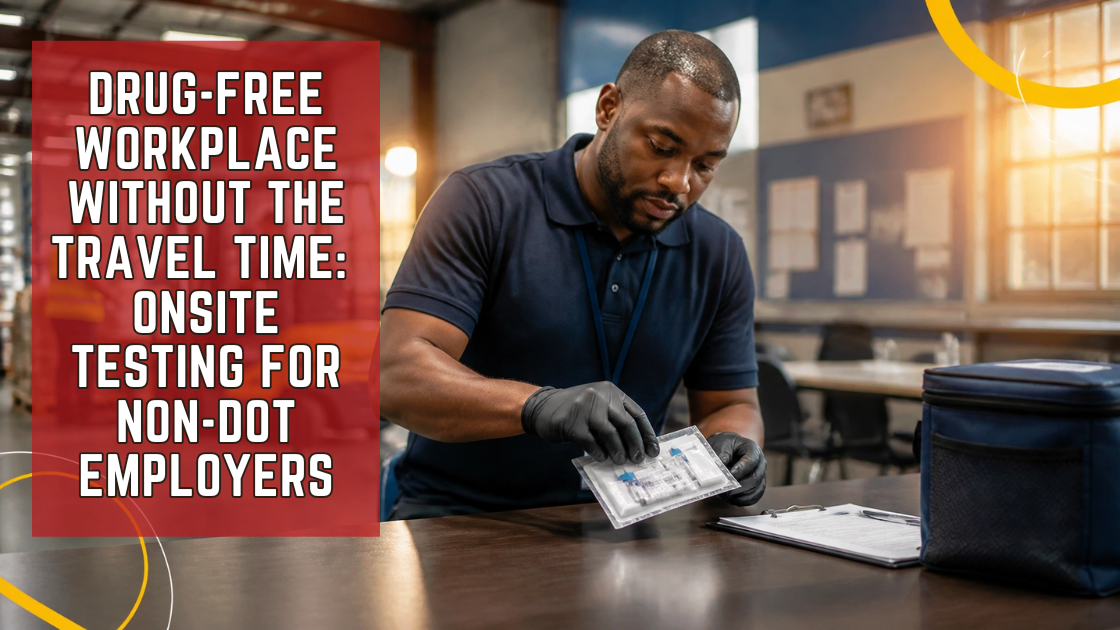
For many employers, maintaining a drug-free workplace policy is about more than checking a compliance box. You want employees to work safely, supervisors to respond appropriately when concerns arise, and your procedures to be consistent if a test result or employment decision is later challenged. The challenge is acting quickly without unnecessarily sending an employee across town to find an available testing facility.
Onsite testing gives you a practical alternative. With READI Collect, you can request professional drug and alcohol collection services at your workplace for post-incident, reasonable-suspicion, and other time-sensitive testing situations. Employees can remain at the location while a trained collector comes to you, reducing travel time and helping your team follow the policy more consistently.
UNDERSTANDING NON-DOT WORKPLACE TESTING
A non-DOT drug or alcohol test is not conducted under the U.S. Department of Transportation’s regulations for federally regulated, safety-sensitive employees. Instead, your program is generally controlled by applicable state laws, your written company policy, and any requirements connected to a state-approved drug-free workplace program or workers’ compensation arrangement. That means you cannot simply copy a DOT testing process and assume it applies to every employee.
State requirements vary significantly. Some states require advance notice, written policies, specific testing procedures, employee rights, certified laboratories, or particular circumstances before an employer may test a current employee. Before implementing or changing your program, review the laws in every state where you operate and have employment counsel validate your policy language.
You should also keep DOT and non-DOT programs separate. Under 49 CFR § 40.13, DOT and non-DOT tests must be separate in all respects, and employers may not use DOT Custody and Control Forms or Alcohol Testing Forms for non-DOT testing. A professional collection provider can help you coordinate the service, but your policy and forms still need to identify the correct testing program.
WHY ONSITE COLLECTIONS ARE PRACTICAL
When an incident occurs, sending an employee to a clinic can create delays and operational disruption. The employee may need to leave the workplace, find transportation, wait for an appointment, and return after the collection is complete. During that time, supervisors may be trying to manage the incident, preserve records, contact management, and keep the rest of the operation moving.
Onsite testing changes the logistics. You can request a collector through the READI Collect app or portal, provide the workplace location, and coordinate a collection where the employee is already present. This reduces unnecessary travel and makes it easier to begin the process promptly while preserving a clear record of when the request was made and how the event progressed.
For employers, the benefit is not simply convenience. A service that supports fast response can make your written policy more usable in real situations, especially when managers are working outside normal business hours or when a facility is located far from a testing center.
POST-INCIDENT TESTING WITHOUT AUTOMATICALLY TESTING EVERY INJURY
Your non-DOT policy should define what types of incidents may justify testing. Depending on state law and your program, that might include a vehicle crash, significant property damage, a workplace event involving possible impairment, or an incident in which an employee may have caused or contributed to an injury. The policy should connect testing to legitimate safety and policy concerns rather than treating every injury report as an automatic testing event.
This distinction matters because the Occupational Safety and Health Administration’s injury-reporting rule prohibits using drug testing or the threat of drug testing as retaliation against an employee who reports a work-related injury or illness. A post-incident test may still be appropriate when it is authorized by your policy and applicable law, but your process should not discourage employees from reporting injuries or hazards.
A sound procedure usually asks several questions before testing:
What happened, and when did it occur?
Was the employee operating equipment, driving, or performing another safety-sensitive task?
Is there a reasonable connection between the incident and possible impairment?
Does the written policy authorize testing in this situation?
Does state law permit the test and establish required safeguards?
Who is responsible for authorizing and documenting the collection?
READI Collect’s onsite model can help you act efficiently after those questions have been addressed. It does not replace your policy, legal review, or management judgment, but it can make the collection step easier to initiate and track.
REASONABLE-SUSPICION TESTING SHOULD BE DOCUMENTED
Reasonable-suspicion testing is generally based on specific, objective observations rather than a rumor or personal hunch. Depending on your policy and state law, those observations may include unusual speech, impaired coordination, a noticeable odor, unsafe behavior, a significant performance change, or other conduct associated with possible drug or alcohol use. Supervisors should be trained to document what they observed without making unsupported medical or criminal conclusions.
Your documentation should normally include the date, time, location, employee’s job function, specific observations, witnesses, and the action taken. Avoid vague statements such as “the employee seemed strange,” because they may be difficult to evaluate later. Instead, record concrete facts, such as changes in balance, slurred speech, repeated safety errors, or behavior that differs noticeably from the employee’s normal conduct.
A trained collector provides an important separation between the supervisor’s decision and the collection itself. The supervisor documents the basis for testing, the employer authorizes the test according to policy, and the collector performs the collection using appropriate procedures. That structure helps create a more consistent and defensible process.
> Quick Tip: Add a reasonable-suspicion observation form to your supervisor toolkit before an incident occurs. Require supervisors to document facts immediately and limit access to the completed form to authorized personnel. When you can request an onsite collector through READI Collect, you can reduce the delay between the documented decision and the collection.
WHAT MAKES A COLLECTION MORE DEFENSIBLE?
A test result is only one part of the record. If an employee challenges the process, you may need to show that the test was authorized, performed consistently, handled professionally, and connected to a valid policy reason. Documentation should tell a clear story from the initial incident or observation through the collection and reporting stages.
Onsite collections can support that record when they include clear event details, collector information, timestamps, and location data. READI Collect provides real-time status reporting and detailed event documentation through its platform, including geo-fenced tracking intended to show where and when the collection process occurred. These records can help your safety, HR, and legal teams understand what happened without relying on scattered text messages or memory.
You should still protect confidentiality throughout the process. Keep results and medical information limited to people with a legitimate need to know, store records securely, and follow your policy for communicating outcomes. A mobile collection platform improves visibility into the event, but it should operate alongside your privacy, recordkeeping, and employee-notification procedures.
HOW READI COLLECT SUPPORTS NON-DOT EMPLOYERS
READI Collect is designed for safety-conscious companies that need a practical response to post-incident, reasonable-suspicion, or other time-sensitive testing needs. Through the patented READI Collect app and portal, you can request an onsite collection and connect with a nationwide network of professional collectors. The platform is available for on-demand situations as well as scheduled onsite testing at your facility.
The company portal provides visibility into current and scheduled collection events, while real-time updates help authorized personnel monitor progress. READI Collect also offers 24/7 customer service and dispatch support, which is especially useful when an incident occurs during an overnight shift, weekend, or holiday. Your employee does not have to spend additional work time traveling to a clinic simply to begin the collection process.
You can learn more about the READI Collect onsite testing system, review the available READI Collect resources, or sign up to schedule onsite testing. The service is not a substitute for state-specific legal guidance, but it can give your team a convenient, structured way to carry out a policy you have already established.
A SIMPLE IMPLEMENTATION CHECKLIST
Before your first time-sensitive testing event, review your policy and operational process. Make sure supervisors know who may authorize a test, how to document observations, and how to protect the employee’s privacy. You should also confirm that your policy addresses post-incident and reasonable-suspicion testing in language that matches the states where your employees work.
Use this checklist to prepare:
Review state-specific non-DOT testing laws.
Create a separate non-DOT policy and forms.
Define post-incident and reasonable-suspicion triggers.
Train supervisors on objective observations and documentation.
Identify who can authorize testing after hours.
Establish how employees will be transported or supervised when necessary.
Create a confidential process for receiving and storing results.
Register your organization with READI Collect.
Confirm workplace locations and after-hours access instructions.
Test the app or portal before an emergency occurs.
Quick Tip: Do not wait until the first incident to search for a mobile collector. Register your company, brief your managers, and confirm your preferred process in advance so your team can focus on safety and documentation when something actually happens.
USEFUL SEARCH TERMS FOR YOUR POLICY TEAM
When researching your program, use precise terms that distinguish non-DOT requirements from transportation regulations. Helpful searches include “non-DOT drug testing laws by state,” “reasonable-suspicion testing workplace policy,” “post-incident drug testing OSHA,” “state drug-free workplace program requirements,” and “non-DOT drug and alcohol testing forms.” You can also review OSHA’s official injury-reporting guidance and consult qualified employment counsel for state-specific questions.
Avoid relying on a generic national policy without checking local requirements. Cannabis rules, employee protections, testing methods, notice requirements, and post-incident standards can change from one jurisdiction to another. Your policy should be reviewed periodically as laws, business locations, job duties, and workplace risks evolve.
IN CONCLUSION
A drug-free workplace policy is most effective when employees and supervisors understand that it will be applied consistently, professionally, and fairly. Onsite testing helps remove a common operational barrier by bringing a trained collector to the workplace instead of requiring employees to travel to a clinic. That can reduce lost work time while supporting a faster, better-documented response.
The governing rules for non-DOT testing come from applicable state law and your company policy, not automatically from FMCSA regulations. Build the policy carefully, train the people responsible for using it, document the reason for each test, and keep DOT and non-DOT processes separate. When you are ready to simplify the collection step, sign up with READI Collect or use the platform to schedule onsite drug and alcohol testing at your workplace.