Electronic Chain of Custody (eCCF) Explained: How Onsite Collections Keep You Audit-Ready
July 27, 2026 · RC Team
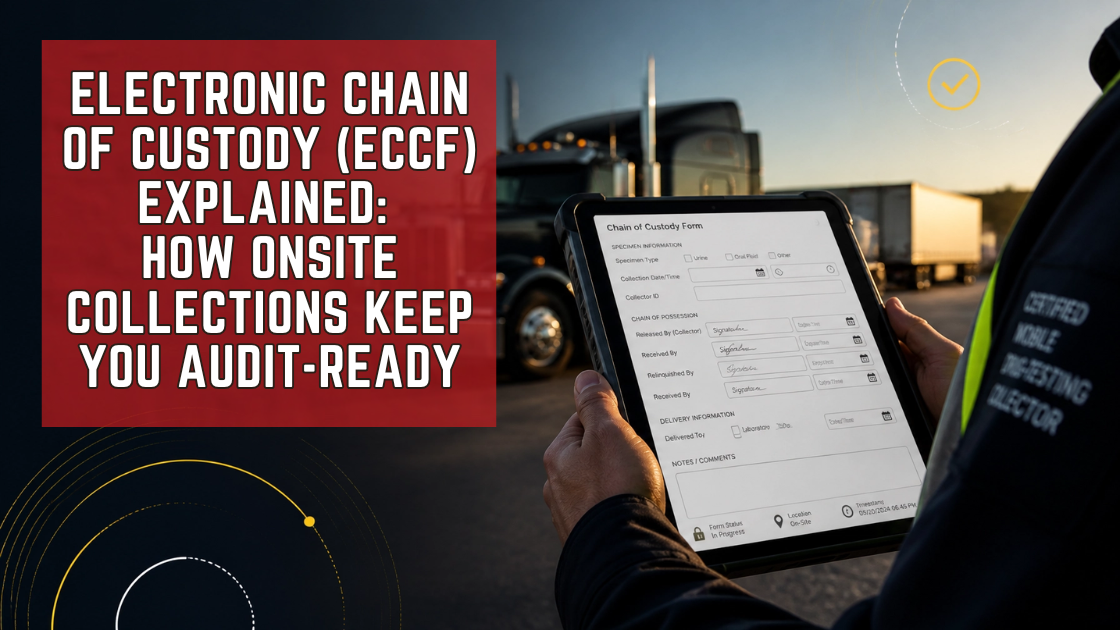
When a DOT drug test is performed, the Chain of Custody Form (CCF) documents what happened to the specimen from collection through laboratory testing and Medical Review Officer (MRO) review. An electronic Chain of Custody Form, commonly called an eCCF, records that same required information digitally instead of relying entirely on a multi-part paper form. For busy carriers, owner-operators, and safety managers, an accurate electronic record can make it much easier to demonstrate that each step was completed correctly.
The important point is that eCCF technology does not eliminate DOT collection requirements or replace careful procedures. The collector must still follow the applicable requirements under 49 CFR Part 40, and your laboratory must be approved to use the applicable eCCF system. When electronic documentation is combined with an onsite collection platform such as READI Collect, you gain a clearer record of the testing event, including when the request was made, where the collector went, and how the collection was completed.
WHAT IS AN ELECTRONIC CHAIN OF CUSTODY FORM?
The CCF is the federal document used to identify a specimen and track its handling during a DOT drug test. It contains information about the employer, donor, collector, specimen, testing facility, and final disposition of the test. The chain of custody is the documented sequence that helps establish that the specimen tested by the laboratory is the same specimen collected from the driver.
An eCCF performs the same basic function in an electronic format. Rather than completing every field by handwriting on a paper form, authorized participants enter information into a secure digital system, and the system transmits the appropriate information to the laboratory, MRO, employer, and donor. The U.S. Department of Transportation explains that the collection process and required information do not change simply because the form is electronic.
An eCCF process may include:
Electronic entry of donor and employer information.
Digital documentation of the collection site and collection time.
Electronic signatures and acknowledgments.
Specimen identification and seal information.
Secure transmission to compatible laboratory and MRO systems.
Electronic delivery or printing of legible copies when required.
System audit trails showing when information was entered or changed.
DOT’s eCCF notice for specimen collectors makes clear that eCCF use is permitted only when the employer’s laboratory has the required approval and the employer elects to use the electronic process. You should confirm that the laboratory, collection site, primary and split laboratories, and MRO systems are compatible before relying on an eCCF workflow.
HOW eCCF REPLACES PAPER CCFs
A paper CCF depends on physical handling, legible handwriting, manual signatures, and the delivery of different copies to different participants. That process can work, but it also creates opportunities for incomplete fields, illegible entries, misplaced copies, and uncertainty about when a particular step occurred. These problems become especially frustrating when a collection takes place after hours, at a remote location, or beside a disabled commercial vehicle.
With an electronic form, the collector can enter information directly into the approved system on a secure tablet or mobile device. The donor reviews the applicable information and provides a digital signature, while the collector digitally certifies the collection steps that they performed. The employer or Designated Employer Representative (DER) can authorize the request, confirm event details, and acknowledge the record through the employer platform, although the exact signature fields depend on the approved laboratory and software configuration.
The process generally looks like this:
You request a DOT drug collection for a specific driver or employee.
The collection event is created with the employer, donor, location, and test information.
A qualified collector accepts the request and travels to the collection site.
The collector verifies the donor and completes the collection according to Part 40.
The driver and collector complete the required electronic signatures or certifications.
The specimen is sealed, documented, and transferred for laboratory testing.
The appropriate electronic records and copies are transmitted to authorized participants.
An eCCF is not always completely paperless. Depending on the laboratory and approved system, certain copies may still need to be printed or provided electronically to the donor, employer, or test facility. DOT’s 49 CFR §40.40 requires employers using an electronic CCF to ensure that authorized participants receive a legible copy.
WHY DIGITAL SIGNATURES AND TIMESTAMPS MATTER
A signature is more useful when it is connected to a defined event, time, user, and record. In an electronic workflow, the system can associate the collector’s certification with the collection step, the driver’s signature with donor review, and the employer’s authorization or acknowledgment with the request record. This creates a more organized history than a stack of forms that must later be reviewed manually.
Timestamps are particularly valuable for time-sensitive testing. If your driver is involved in a qualifying accident, you may need to demonstrate when the incident was reported, when the testing request was made, when a collector accepted the request, and when the collection was completed. A detailed timeline can help show that you acted promptly, even if circumstances outside your control affected the final completion time.
A digital record can also help identify gaps before an auditor does. For example, you may be able to see whether a collector has arrived, whether donor verification is complete, whether the specimen has been sealed, or whether a required document is still pending. That visibility gives you an opportunity to correct an administrative issue while the event is still active.
> Quick Tip: Do not treat an electronic signature as a substitute for a compliant collection procedure. Train your drivers, DERs, and supervisors on what each person must do, and confirm that your laboratory’s eCCF process is approved and compatible before implementation.
HOW GEO-FENCED ONSITE RECORDS SUPPORT AN AUDIT
An eCCF documents the testing chain, while an onsite collection platform can add important event-management information around that chain. READI Collect uses a patented application and geo-referenced dispatch technology to connect employers with a nationwide network of more than 3,000 professional collectors. That combination can create a stronger operational record for collections performed at a terminal, job site, roadside location, or other remote setting.
READI’s portal provides reports for each event, including the precise location and timestamps associated with the request and each step of the interaction. Depending on the event, the record may also include scene photographs, witness accounts, weather conditions, road conditions, and other relevant details. During a DOT audit, those records can help explain not only what testing documentation was completed, but also how your company responded to the incident.
Geo-fenced information is especially useful when the testing location is not a traditional clinic. A record showing that the collector arrived at the designated location can help connect the digital collection record to the actual event. It also gives you a clearer way to review whether the collection occurred at the employer address, accident location, or other properly documented site.
WHAT READI COLLECT REPORTS CAN SHOW
Your READI Collect company portal is designed to give you visibility into current, scheduled, and completed collection events. Instead of waiting for several people to send separate updates, authorized users can review the event status and available reports in one place. This is especially helpful when the driver is away from the terminal and the collection occurs outside normal business hours.
Depending on the type of event and information available, reports may include:
The exact or recorded collection location.
The time the request was initiated.
The time a collector accepted the assignment.
Arrival and interaction timestamps.
Collection completion information.
Scene photographs.
Witness accounts.
Weather and road conditions.
Collector and event details.
Digital copies of required testing documents.
Status information and notifications.
These records should be maintained securely and accessed only by authorized personnel. DOT states that electronic CCF users must establish appropriate confidentiality, physical security, access controls, and computer security measures. You can review the agency’s eCCF guidance and confirm system-specific requirements with your laboratory or eCCF provider.
READI Collect also provides audit assistance when an event is reviewed by a DOT agent, insurance representative, or law enforcement agency. When necessary, the team can provide expert witness support, including in-court testimony. That support can be valuable when you need an experienced third party to explain the collection process, event timeline, or records produced by the system.
eCCF AND ONSITE TESTING: A PRACTICAL CHECKLIST
Using an eCCF successfully requires more than giving a collector a tablet. You need a written process that explains who requests testing, who receives notifications, how drivers respond after an incident, and how records are retained. Your process should also distinguish between DOT drug testing documentation and DOT alcohol testing documentation, because alcohol testing uses separate procedures and an Alcohol Testing Form rather than the drug-testing CCF.
Before your next audit or incident, confirm that you can answer these questions:
Is your laboratory approved for the eCCF system you intend to use?
Are the laboratory, MRO, collection site, and related systems compatible?
Can the driver receive a legible copy of the applicable form?
Are employer and DER permissions limited to authorized users?
Can you retrieve completed records quickly?
Does your onsite process record the actual collection location?
Are your drivers trained to report incidents and request testing promptly?
Do you know how to document an unsuccessful or delayed testing attempt?
Are digital records backed up and retained for the required period?
Can your service provider assist if an auditor requests clarification?
The thing is, an audit-ready program is built before an audit begins. When your company combines a compliant laboratory process, trained personnel, secure electronic records, and rapid onsite collection support, you reduce the administrative scramble that often follows a serious incident.
IN CONCLUSION: MAKE EVERY TESTING EVENT TRACEABLE
An electronic Chain of Custody Form replaces much of the manual paper handling involved in a DOT drug test, but it does not reduce the importance of accurate collection procedures. The driver, collector, employer, laboratory, and MRO still have defined responsibilities, and your records must remain secure, legible, retrievable, and properly retained. The advantage is that electronic documentation can connect signatures, timestamps, specimen information, and transmission records in a more accessible format.
For onsite events, READI Collect adds a practical layer of visibility through rapid dispatch, geo-referenced event tracking, detailed portal reports, and 24/7 support. If an auditor asks what happened, you have more than a single form to review; you may also have the location, timeline, scene documentation, witness information, and surrounding conditions. READI’s audit assistance and expert witness support can help you present that record clearly when the details matter most.
DOT rules, laboratory approvals, and technology requirements can change, so review your program regularly and confirm current requirements with the appropriate federal agency, laboratory, or compliance professional. You can review READI Collect’s onsite testing services, follow the collection tutorials, or schedule an onsite collection. To get started, sign up for onsite testing with a company subscription of $39.99 per year after a 30-day free trial, with each collection priced separately based on the collector and test type.
Helpful Search Terms and Resources
If you are researching electronic chain-of-custody compliance, these terms can help you find reliable guidance:
DOT electronic Chain of Custody Form.
eCCF-approved laboratory.
49 CFR Part 40 CCF requirements.
DOT drug testing record retention.
DOT collection site security.
FMCSA drug and alcohol testing rules.
Onsite post-accident drug testing.
Designated Employer Representative responsibilities.
DOT audit-ready drug testing records.
HHS-approved eCCF systems.
For official information, review the FMCSA overview of drug and alcohol rules, the DOT Part 40 regulations, and the DOT eCCF guidance for collectors.