Mobile Drug Testing for Truck Drivers: How On-Demand Onsite Collections Actually Work
May 18, 2026 · RC Team
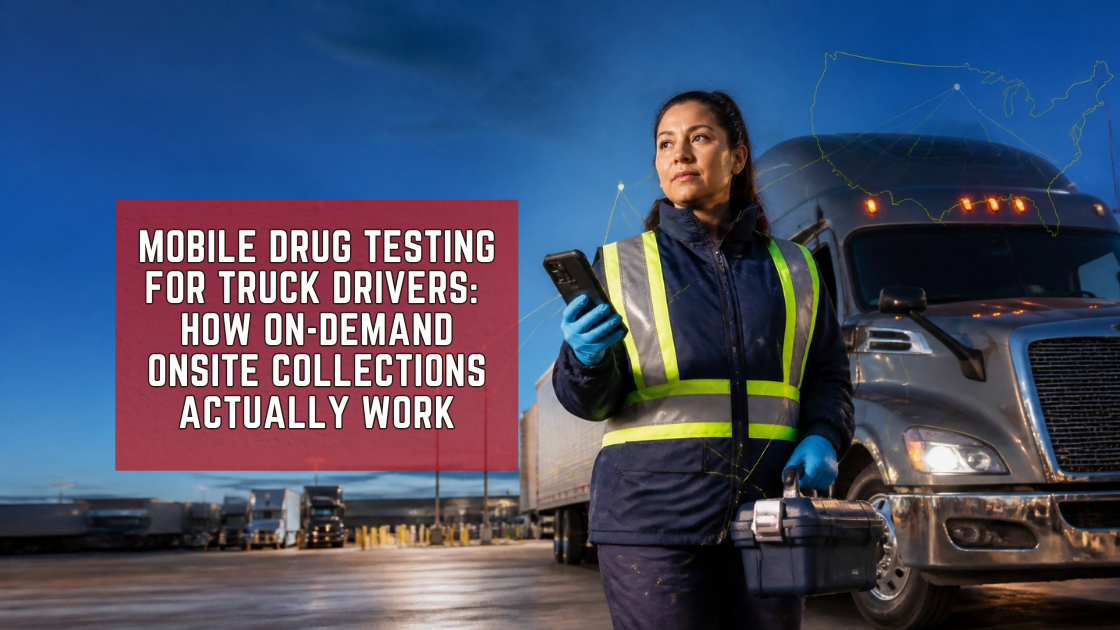
When a truck accident occurs, every minute matters. A driver may be at the scene, in a hospital, at a terminal, or waiting for roadside assistance, while the carrier must determine whether DOT post-accident testing is required and arrange the collection within strict time limits.
The traditional solution was to search for an open clinic, send the driver there, and hope the facility could complete the process correctly. READI Collect modernizes that process by bringing a qualified collector to the driver through a patented mobile app and a nationwide network of more than 3,000 certified collectors.
Instead of asking the driver to leave the scene, you can request an onsite collection, monitor the response, and access event documentation through your company portal. The result is a faster, more transparent approach to time-sensitive drug and alcohol testing.
WHAT IS MOBILE DRUG TESTING?
Mobile drug testing is the delivery of a qualified collector and compliant collection supplies directly to the location where testing is needed. For truck drivers, that location may be an accident scene, a carrier terminal, a repair facility, a hospital, or another safe location where the driver can be properly identified and tested.
The collection itself must still follow applicable DOT and 49 CFR Part 40 requirements. A mobile collection is not a shortcut around federal procedures, and the same identification, privacy, documentation, specimen handling, and chain-of-custody standards apply as they would at a fixed clinic.
For FMCSA-regulated carriers, the employer remains responsible for determining whether an accident meets the applicable post-accident testing criteria. Under FMCSA guidance, testing is generally required after a qualifying fatality, injury accident, or tow-away accident when the required citation conditions are met.
WHY THE OLD CLINIC MODEL CAN CREATE PROBLEMS
The fixed-clinic model can work for scheduled testing, but it becomes more difficult when a collection must happen quickly. A driver may be several miles from the nearest clinic, traveling through a rural area, or involved in an incident outside normal business hours.
You may also have to coordinate several moving parts at once:
Confirm whether the clinic is open.
Verify that it performs DOT collections.
Determine whether it can complete both drug and alcohol testing.
Arrange transportation for the driver.
Confirm that the driver arrives within the applicable testing window.
Make sure the correct federal forms and collection procedures are used.
Track the event while managing the accident, vehicle, cargo, and law-enforcement response.
The issue is not simply inconvenience. DOT post-accident alcohol testing must be completed as soon as practicable and generally no later than eight hours after the accident, while drug testing must generally be completed within 32 hours. When a carrier spends the first hour searching for an available clinic, the remaining window can become uncomfortably short.
> Quick Tip: Build your testing response before an incident occurs. Saving the READI Collect process in your emergency response plan gives dispatchers, safety managers, and designated employer representatives a clear next step when a driver needs immediate assistance.
HOW READI COLLECT’S ONSITE PROCESS WORKS
READI Collect is designed to make an urgent collection request simple to initiate and easy to monitor. Through the READI Collect app or company portal, you submit the event details and request the type of testing needed at the location where the driver is available.
The request is then distributed through READI Collect’s technology and professional collector network. The system helps identify an available certified collector near the requested location, allowing the collector to accept the assignment and respond without requiring your team to call clinics one by one.
A typical request includes information such as:
Company and on-site contact information.
Exact collection address or accident-scene location.
Driver or donor information.
Testing requirements.
Number of donors.
Preferred timing or urgency.
Laboratory or chain-of-custody details when applicable.
Any supplies or special instructions needed for the event.
READI Collect provides 24/7 customer service and dispatch support, which is important because accidents and other testing events do not follow a nine-to-five schedule. The company also offers scheduled onsite collections for terminals and other workplaces when you need to test multiple employees at a single location.
STEP 1: SEND THE REQUEST FROM THE APP OR PORTAL
The first step is to open the READI Collect app or access the company portal from a mobile device or computer. You provide the event location and testing details, then submit the request to the collector network.
This approach reduces the time spent searching for a provider manually. It also creates a digital record of when the request was initiated, what information was provided, and how the event progressed.
The faster you enter complete information, the easier it is for dispatch and the collector to respond. If the collection is related to an accident, use the most precise location available and update the location if the driver moves to a hospital, terminal, or other safe collection site.
STEP 2: A NEARBY CERTIFIED COLLECTOR IS DISPATCHED
After the request is submitted, READI Collect’s nationwide network of more than 3,000 collectors helps connect the event with an available professional in the area. The goal is to locate a collector who can respond quickly enough to support the required testing timeline.
The collector arrives with the appropriate mobile supplies and performs the collection according to the applicable testing program. The collector must still verify the donor’s identity, explain the process, protect the integrity of the specimen, and complete the required documentation.
A mobile collection does not mean that testing takes place casually or without privacy. The collector must identify a suitable and secure area, follow the applicable procedures, and document the actual collection location as required by the federal form and testing program.
STEP 3: THE COLLECTION TAKES PLACE ONSITE
The collector can meet the driver at the accident scene when conditions are safe and practical, or at another location where the driver is receiving care or waiting for transportation. In some cases, the collection may take place at a carrier terminal, maintenance facility, or other designated workplace.
The right location depends on safety, access, privacy, and the driver’s condition. If the driver requires emergency medical attention, medical care comes first, and the employer should coordinate with the appropriate personnel to determine when and where testing can occur.
For a DOT drug test, the Federal Drug Testing Custody and Control Form must be used. When an electronic CCF is used, the participating collection site, laboratory, medical review officer, and employer must have compatible systems, and the required information must be protected and transmitted securely.
STEP 4: THE eCCF DOCUMENTS THE CHAIN OF CUSTODY
The electronic custody and control form, or eCCF, creates a digital record of the collection and specimen transfer process. It helps document the donor, collector, collection location, timing, signatures, specimen information, and subsequent handoffs.
The chain of custody begins at the collection. The collector completes the required steps, seals the specimen according to the applicable procedure, and transfers it for laboratory processing while maintaining the documentation needed to establish specimen integrity.
That documentation matters during an audit, dispute, or compliance review. A well-managed eCCF process can help your team confirm what happened, when it happened, who handled the specimen, and whether the required procedures were followed.
STEP 5: YOU MONITOR THE EVENT IN REAL TIME
Once the event is active, your team can monitor collection status through the READI Collect company portal. READI Collect describes its portal as a place to view current and scheduled events, reports, time stamps, locations, and other event details.
This visibility is especially useful when a safety manager or designated employer representative is coordinating an incident from another state. Instead of repeatedly calling a driver, collector, or clinic for updates, you can review the event status and documentation through the platform.
Depending on the event, available reporting may include collection milestones, precise location information, photographs, witness accounts, weather or road conditions, and other details. READI Collect also provides audit assistance when an event is reviewed by a DOT agent, insurer, or law-enforcement agency.
MOBILE TESTING VERSUS A FIXED CLINIC
A fixed clinic may still be the right choice for routine pre-employment testing, scheduled random testing, or drivers who are already near an open collection site. However, onsite testing is often more practical when the driver is at an accident scene, outside normal clinic hours, or too far from a facility.
The most important distinction is speed and coordination. Mobile testing does not remove your compliance responsibilities, but it can reduce the logistical delays that make those responsibilities harder to fulfill.
WHAT CARRIERS SHOULD DO BEFORE AN ACCIDENT
A response plan is most useful when it is prepared before the emergency. Make sure your dispatchers, safety managers, and other responsible personnel know who can authorize a collection request and how to access the READI Collect platform.
Your preparation checklist should include:
Enrolling your company with READI Collect.
Adding the service to your written accident-response procedures.
Identifying authorized users for the app and company portal.
Training personnel to document the accident time and location.
Keeping driver and designated employer representative contact information current.
Reviewing your process for deciding whether DOT testing is required.
Establishing how your team will document delays or situations in which testing cannot be completed within the required window.
> Quick Tip: Do not wait until an accident occurs to search for a mobile collector. Register in advance so your team can focus on driver safety, scene coordination, and accurate reporting instead of creating an account during a time-sensitive event.
IN CONCLUSION
Mobile drug testing gives carriers a practical way to respond when a truck driver needs time-sensitive testing away from a traditional clinic. With READI Collect, you can submit a request through the app or portal, connect with a nearby certified collector, complete the collection onsite, and monitor the event through digital reporting.
The service does not replace your obligation to understand FMCSA and DOT rules. Instead, it gives you a more efficient operational tool for meeting those obligations while reducing unnecessary travel, phone calls, and uncertainty.
Regulations, forms, and testing procedures can change, so review your program regularly and consult the applicable FMCSA resources and DOT regulations. If you need a convenient way to arrange drug and alcohol testing, visit READI Collect to sign up or schedule onsite drug and alcohol testing.
Helpful Search Terms and Resources
Mobile drug testing for truck drivers
Onsite DOT post-accident testing
Emergency alcohol testing for CDL drivers
DOT drug testing collection at accident scene
FMCSA post-accident testing requirements
eCCF chain of custody
Mobile specimen collector
24/7 DOT drug and alcohol testing