Non-DOT Employers: Why a Drug-Free Workplace Policy Needs Onsite Testing Too
June 1, 2026 · RC Team
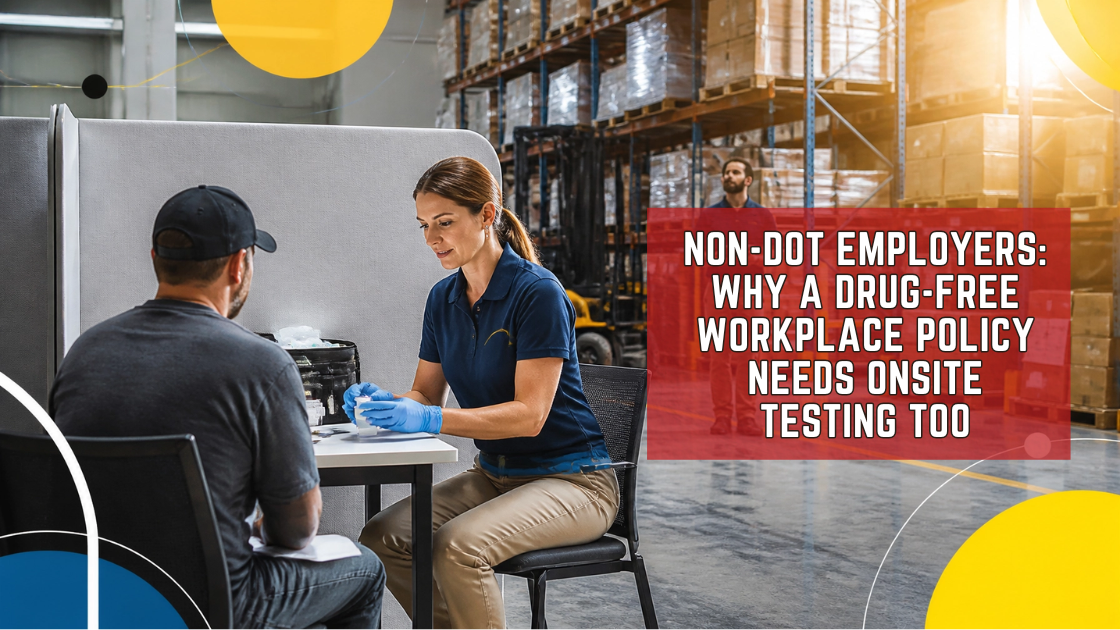
A drug-free workplace policy is only as effective as your ability to apply it consistently when a safety-sensitive situation occurs. For non-DOT employers, that may mean arranging a reasonable-suspicion test during working hours or sending a qualified collector to the scene after a workplace accident. Onsite testing gives you a practical way to respond quickly, protect your employees, and document that your policy was followed fairly.
NON-DOT TESTING STILL REQUIRES A CLEAR FRAMEWORK
DOT regulations do not apply to every employer, and non-DOT testing programs are generally governed by your written company policy, applicable state and local laws, and any federal requirements that apply to your organization. Most private employers are not universally required to maintain a drug-testing program, although certain federal contractors and grant recipients may have additional obligations under the Drug-Free Workplace Act. The Substance Abuse and Mental Health Services Administration (SAMHSA) recommends creating a written policy that reflects your workplace needs and applicable legal requirements.
Before implementing onsite testing, your policy should clearly explain who is covered, what conduct is prohibited, and when testing may occur. It should also address reasonable suspicion, post-incident testing, alcohol testing, marijuana-related considerations, employee notice, confidentiality, consequences, and any available assistance. Because state laws can differ substantially, you should have your policy reviewed by qualified employment counsel or a knowledgeable testing administrator before putting it into practice.
> Quick Tip: Do not copy a DOT policy and assume it works for your non-DOT workforce. Use DOT-style documentation and collection safeguards as a strong best practice, but tailor the testing triggers and policy language to your industry, workforce, and state requirements.
REASONABLE-SUSPICION INCIDENTS CANNOT ALWAYS WAIT
Reasonable-suspicion testing is used when specific, documented observations suggest that an employee may be impaired, using prohibited substances, or otherwise unable to safely perform assigned duties. Depending on your policy and state law, relevant observations may include slurred speech, unusual behavior, the odor of alcohol, impaired coordination, significant performance changes, or repeated unsafe conduct. A supervisor should document objective facts rather than rely on rumors, assumptions, stereotypes, or a single vague impression.
The timing of these situations creates an immediate operational challenge. An employee may be at a warehouse, construction site, office, retail location, or remote facility when concerns arise, and the nearest clinic may be far away or closed for the day. With an onsite collector, you can arrange a confidential collection at the workplace while the facts are still current and without asking the employee to travel across town.
Your policy should also explain what happens before and after the test. The employee should be removed from safety-sensitive duties, provided with clear instructions, and transported safely if impairment is suspected rather than allowed to drive. A supervisor should record the time, location, observations, witnesses, policy provision involved, and steps taken to protect the employee and everyone else at the workplace.
POST-INCIDENT TESTING HELPS YOU RESPOND AFTER AN ACCIDENT
A post-incident test may be appropriate after a workplace accident, injury, property-damage event, or other event identified in your written policy. Non-DOT employers can define qualifying incidents more broadly than DOT rules, but your criteria should be specific enough that employees and supervisors understand when testing may be required. For example, your policy might address incidents involving company vehicles, forklifts, heavy equipment, machinery, inventory, or serious near-misses where permitted by applicable law.
Testing should never replace immediate medical care, emergency response, or an investigation into unsafe conditions. First, address injuries and secure the scene, then follow your policy for removing the employee from duty and arranging the collection. A mobile collector can come to the workplace or incident location so your team can preserve time-sensitive information without sending the employee into an unfamiliar process alone.
READI Collect provides on-demand and scheduled onsite collection services for post-accident, reasonable-suspicion, and other time-sensitive testing needs. Its platform connects employers with a nationwide network of more than 3,000 collectors, while its customer portal can provide event status, timestamps, and detailed reporting. You can learn more about the available process through the READI Collect services page.
ONSITE TESTING REDUCES LOST WORK TIME
Sending an employee to a clinic can create more disruption than many employers expect. The employee may need to leave the facility, wait for transportation, locate an open testing site, complete paperwork, and return to work or home. Meanwhile, a supervisor may have to leave the jobsite, coordinate the appointment, and manage coverage for the employee’s position.
Onsite testing reduces those logistical demands by bringing the collection process to your location. Your operations team can keep other employees focused on their responsibilities, and the individual being tested does not have to navigate an unfamiliar clinic during an already stressful event. This does not eliminate the need for safe transportation, privacy, or proper documentation, but it can make the overall response faster and more orderly.
The convenience is especially valuable for employers with multiple shifts, remote facilities, warehouses, manufacturing operations, and businesses that operate nights or weekends. READI Collect offers 24/7 customer service and dispatch support, along with scheduled onsite testing for employers that want a planned collection at their location. To request a collection, you can use the READI Collect scheduling page.
> Quick Tip: Build your response plan before an incident occurs. Save your testing provider’s contact information, identify who can authorize a collection, and make sure supervisors know how to protect the employee, preserve privacy, and arrange transportation.
CONSISTENCY AND DOCUMENTATION MATTER IN A DISPUTE
A testing program can be challenged if employees believe it was applied selectively, triggered by personal bias, or handled differently from one incident to another. Consistent procedures help demonstrate that the company acted according to a written policy rather than improvising after an unfavorable event. This is particularly important when an employee disputes discipline, termination, a test result, or the company’s interpretation of the incident.
Your records should connect the event to the policy and the collection. Depending on your program, maintain the employee’s policy acknowledgment, supervisor observations, incident report, date and time of the collection, location, identification verification, specimen type, laboratory information, chain-of-custody records, result, and any review or appeal documentation. Keep sensitive information confidential and limit access to people with a legitimate business need.
A qualified mobile collection provider should use secure handling procedures, appropriate privacy controls, tamper-evident materials, and clear transfer records. READI Collect’s reporting system is designed to provide event details such as location, timestamps, and completion information, and the company describes audit assistance for qualifying events. Those records do not replace your responsibility to maintain a legally sound policy, but they can make it easier to show what happened and when.
ONSITE TESTING REINFORCES A SAFETY-FIRST CULTURE
Employees notice how an organization responds to safety concerns. When your company has a clear process and can arrange a professional collection without unnecessary delay, it communicates that workplace safety is a real operating priority. The message is not simply that employees may be disciplined; it is that everyone deserves a safe environment and that potential impairment concerns will be handled respectfully and consistently.
A strong program should also explain available support. SAMHSA recommends that employers consider confidentiality, employee assistance, education, treatment or recovery support, and fair implementation when developing a drug-free workplace policy. Your approach can combine accountability with practical resources instead of treating every testing event as only a punitive action.
Training is another essential part of the culture. Supervisors should learn how to recognize and document objective observations, avoid diagnosing substance use, follow the policy, protect employee privacy, and contact the appropriate decision-maker. Employees should know what the policy prohibits, when testing may occur, how results are handled, and whom they can contact with questions.
A PRACTICAL NON-DOT ONSITE TESTING CHECKLIST
Use this checklist when reviewing your program:
Confirm which federal, state, and local rules apply to your workplace.
Define reasonable-suspicion and post-incident testing triggers in writing.
Explain whether alcohol, marijuana, prescription medication, or other substances are covered.
Provide the policy to employees and document receipt or acknowledgment.
Train supervisors on objective observations, documentation, and response procedures.
Identify who can authorize a test and who contacts the collection provider.
Arrange safe transportation when an employee should not drive.
Protect privacy during onsite collection.
Use documented identification, chain-of-custody, specimen handling, and laboratory procedures.
Record the incident facts, collection details, result, and any follow-up action.
Review the policy regularly as laws, business operations, and workplace risks change.
The SAMHSA employer resources are useful for policy-development concepts, but they are not a substitute for state-specific legal advice. You may also want to review search terms such as non-DOT drug testing policy, reasonable suspicion workplace testing, post-incident drug testing, mobile workplace drug testing, onsite alcohol testing, and state drug-testing laws as you evaluate your program.
IN CONCLUSION: MAKE THE RESPONSE PLAN AS READY AS THE POLICY
A drug-free workplace policy should do more than sit in an employee handbook. It should give your supervisors a clear, consistent process for responding to reasonable-suspicion concerns and workplace incidents while protecting employees, operations, and the integrity of your records. Onsite testing makes that process more practical by bringing a trained collection professional to the location when time, privacy, and continuity matter.
READI Collect combines on-demand technology, a nationwide collector network, 24/7 dispatch support, onsite collection, and event reporting for safety-conscious non-DOT employers. If you want a convenient way to handle workplace collections, you can sign up with READI Collect to get started. If you need help coordinating a specific event, you can schedule onsite drug and alcohol testing through READI Collect.
This article provides general educational information and is not legal advice. Review your drug-free workplace policy with qualified counsel to address the laws and requirements applicable to your organization.