Post-Incident Testing for Construction and Warehouse Teams: What Non-DOT Employers Get Wrong
November 9, 2026 · RC Team
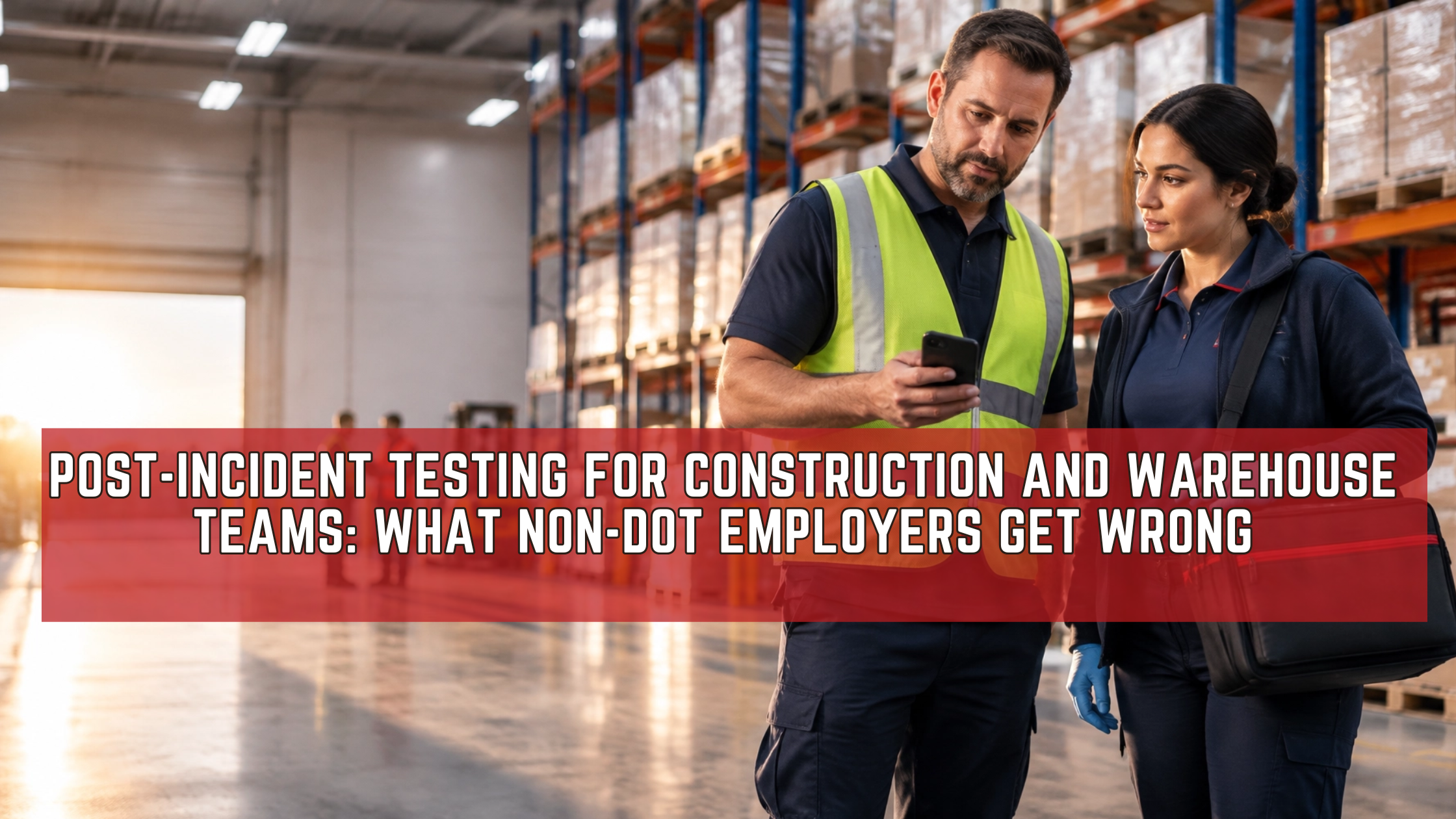
A workplace incident can leave you balancing urgent priorities: getting medical help, securing the area, documenting what happened, and deciding whether post-incident drug or alcohol testing is appropriate. For non-DOT employers, that decision can be especially confusing because there is no single federal testing framework that tells every construction company, manufacturer, warehouse, or logistics operation exactly what to do.
The most common mistake is treating every incident as an automatic testing trigger. Testing can be one part of a safety investigation, but the reason for testing, the people selected, and the policy behind the decision all matter. A clear, consistently applied process helps you respond promptly while respecting employee rights and applicable laws.
NON-DOT DOESN’T MEAN “NO RULES”
DOT testing requirements apply to specific transportation employees and employers covered by federal rules; they do not automatically govern your entire non-DOT workforce. If your team works in a warehouse or on a construction site and is not subject to DOT testing rules, you generally need to rely on your own written workplace policy, applicable state and local laws, and other relevant federal requirements.
OSHA’s injury-reporting rule is an important consideration. Under 29 CFR 1904.35(b)(1)(iv), an employer must not discharge or otherwise discriminate against an employee for reporting a work-related injury or illness. OSHA explains that post-incident testing may be appropriate when it serves a legitimate safety purpose, but a policy or practice that deters employees from reporting injuries can create problems.
That distinction is practical: testing should help you understand an incident, not punish someone for reporting it. OSHA’s interpretation of the rule describes the difference between a safety-focused investigation and testing used to penalize a person who reports an injury.
MISTAKE #1: TESTING AUTOMATICALLY AFTER EVERY INJURY
A blanket “test after every injury” rule may seem easy to administer, but it can lead to testing that has no reasonable connection to the event. OSHA has pointed to circumstances such as repetitive-motion injuries or incidents involving an innocent bystander as examples where drug use may be unlikely to have contributed. Automatically testing in situations like these can discourage accurate injury reporting.
Instead, use objective facts to decide whether testing is relevant to a particular investigation. Consider whether substance use could reasonably have contributed, whether there are observable facts that support that concern, and whether other people whose conduct may have contributed are being treated consistently. Document the reason for the decision and follow your policy rather than improvising under pressure.
Quick Tip: Ask, “What safety question would this test help us answer?” If the answer has no meaningful connection to the incident, pause and consult your policy or employment counsel before proceeding.
MISTAKE #2: TESTING ONLY THE INJURED EMPLOYEE
Selecting only the injured worker can make testing appear punitive, particularly if other people’s actions may also have contributed. OSHA’s guidance recommends considering whether all employees whose conduct could have contributed to an incident are treated consistently. The goal is to investigate what happened fairly, not to single out the person who was hurt or reported the event.
Build a neutral decision process into your written policy. Depending on the incident, that may mean considering the actions of equipment operators, supervisors, witnesses, or others involved in the work, rather than relying only on the injury report. Keep the scope proportionate and document why the employees selected are relevant to the investigation.

MISTAKE #3: ASSUMING A TEST RESULT PROVES IMPAIRMENT
A drug test result does not necessarily establish that someone was impaired when an incident occurred. Different tests detect different substances over different windows of time, and a result may not show when a substance was used or whether it affected a person’s ability to work at the time in question. For this reason, test results should be considered alongside the incident facts, not treated as a complete explanation.
Alcohol testing raises its own timing considerations. OSHA has said that employers may consider whether a test can measure impairment at the time of the incident when such testing is available; alcohol testing is one example discussed in its interpretation of the recordkeeping rule. Your policy should clarify which testing methods you use, how results are handled, and who is authorized to review them.
MISTAKE #4: CONFUSING OSHA REPORTING WITH DRUG TESTING
An OSHA reporting deadline is not a drug-testing deadline. Where applicable, employers must report a work-related fatality to OSHA within eight hours and a work-related inpatient hospitalization, amputation, or loss of an eye within 24 hours. Those requirements are separate from any decision to arrange post-incident testing; see OSHA’s reporting requirements.
In the immediate aftermath of an incident, prioritize medical care and scene safety. Then follow your established process for documenting the event, preserving relevant evidence, making any required reports, and evaluating whether testing is warranted. Don’t delay urgent care or an OSHA report while trying to arrange a test.
MISTAKE #5: WAITING UNTIL AN INCIDENT TO FIGURE OUT THE PROCESS
When a manager is searching for a collector, locating a facility, and trying to interpret a policy all at once, delays and inconsistent decisions are more likely. A better approach is to decide in advance who can authorize testing, how the decision is documented, which testing options are available, and who communicates with employees. Your policy should also explain how results and related information are handled.
Onsite collection can make the response more convenient by bringing a professional collector to your facility or jobsite, rather than requiring an employee to travel to a testing location. READI Collect’s services include on-demand onsite collection requests through a patented app, a nationwide collector network, real-time event reporting, and geo-fenced tracking. Its built-in decision tree can help guide appropriate workflows; it does not replace your policy, legal review, or judgment about whether testing is justified.

A PRACTICAL POST-INCIDENT CHECKLIST
Before an incident, review your policy with employment counsel familiar with the states where your workers operate. State laws can affect who may be tested, when and how testing may occur, how results are used, and what notice or procedural safeguards are required. A policy that works in one location may need adjustments for another.
When an incident occurs, use a consistent checklist:
- Address immediate safety and medical needs. Secure the area and arrange care before focusing on testing.
- Record the facts. Note the time, location, work activity, equipment involved, and relevant observations without making unsupported conclusions.
- Assess whether testing is connected to the investigation. Identify the objective reason for considering it and who may have contributed.
- Apply your policy consistently. Avoid selecting someone solely because they reported an injury or were hurt.
- Arrange the appropriate collection. Follow applicable law and policy for timing, testing method, consent, and documentation.
- Keep testing separate from required reporting. Track any OSHA reporting duties and deadlines independently.
A rapid response is valuable, but speed should support a fair process, not replace one. READI Collect’s onsite collection service is designed to help employers request a collector and monitor collection-event progress, which can reduce the scramble to coordinate logistics after an incident.
IN CONCLUSION: MAKE YOUR RESPONSE FAIR, CONSISTENT, AND READY
Non-DOT employers do not have a single federal post-incident testing rule for every workplace scenario, but that does not mean every approach is appropriate. OSHA prohibits retaliation against employees for reporting work-related injuries, and state laws and other workplace requirements may add further obligations. Review your policy regularly, train managers on how to apply it, and document the facts behind each decision.
The most dependable process starts well before an incident: clear criteria, consistent treatment, prompt attention to safety, and a practical way to arrange collections when testing is warranted. To learn how READI Collect supports onsite post-incident testing for non-DOT and DOT-regulated workplaces, visit READI Collect.