READI Collect vs. the Fixed-Site Clinic: Why On-Demand Onsite Testing Wins the Race Against Time
September 21, 2026 · RC Team
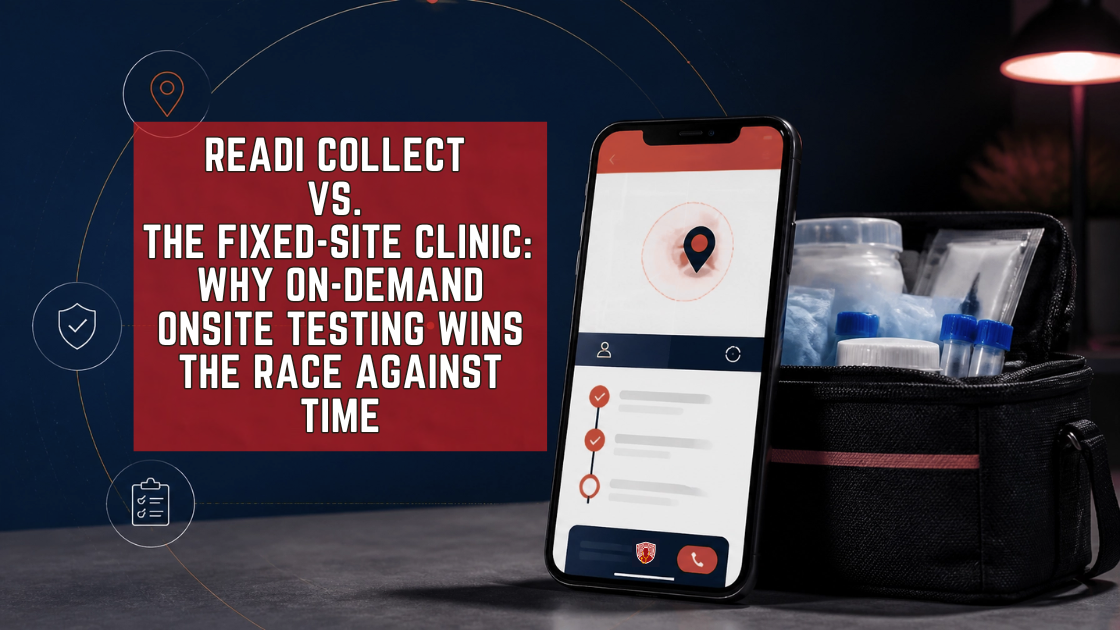
When a post-accident or other time-sensitive testing event occurs, the testing process is a race against the clock. You may need to determine whether a DOT test is required, locate an available collector, coordinate transportation, confirm the clinic can perform the correct test, and preserve accurate documentation. A fixed-site clinic can handle compliant collections, but the traditional model often adds travel, waiting, and after-hours uncertainty to an already urgent situation.
READI Collect is designed around a different model: instead of sending the employee to a clinic, you request a certified mobile collector through a patented app. The collector comes to the employee’s location, while your team receives status updates and event documentation through the platform. For post-accident, reasonable suspicion, and other time-sensitive testing, that difference can help you respond faster and create a clearer compliance record.
THE TIME PRESSURE BEHIND POST-ACCIDENT TESTING
Before comparing collection models, you need to understand the applicable DOT time limits. Under 49 CFR § 382.303, a qualifying post-accident event may require alcohol and controlled-substance testing for the surviving driver performing safety-sensitive functions. The exact testing requirement depends on factors such as a fatality, a citation, immediate medical treatment away from the scene, or disabling damage requiring a tow.
For alcohol testing, the preferred target is within two hours of the accident, and the employer must document the reasons for a delay after two hours. If the alcohol test is not completed within eight hours, the employer must stop attempts and maintain the required explanation. The drug test must be completed as soon as practicable and no later than 32 hours after the accident, or the employer must stop attempts and document why it was not completed.
Alcohol: Aim for completion within two hours, with an eight-hour regulatory cutoff.
Drugs: Complete the required test within 32 hours.
Medical care: Never delay emergency treatment to arrange testing.
Documentation: Record the timing, circumstances, and reasons for any delay.
Quick Tip: Build your post-accident procedure around the first few minutes after an incident. A written decision process and an immediately available collection solution are more useful than a clinic list that no one can access at 2:00 a.m.
FIXED-SITE CLINICS ADD STEPS TO THE PROCESS
A fixed-site clinic requires the employee to travel from the incident location to a testing facility. That may involve arranging a ride, finding an open clinic, confirming that the clinic performs the necessary DOT collection, navigating traffic, and waiting for registration or collection staff. Each step consumes time that could otherwise be used to complete the alcohol test within the preferred two-hour window.
Clinic-based testing can also become difficult when an incident happens outside normal business hours. Nights, weekends, holidays, rural locations, and multi-location operations can all create additional obstacles, even when a clinic is technically available somewhere in the area. If your driver is far from the nearest facility, the distance between “we have a clinic on file” and “the test has been completed” can be substantial.
A fixed-site clinic may still be a practical option when it is open, nearby, and prepared to perform the correct collection. The issue is reliability during urgent events, not whether clinics can perform compliant testing. When your procedure depends entirely on a facility’s hours and location, you carry more responsibility for managing every delay between the accident and the collection.
ON-DEMAND ONSITE COLLECTION BRINGS THE COLLECTOR TO YOU
READI Collect reverses the traditional workflow. After an incident, you can access READI from a computer, browser, or mobile device and submit a collection request through the platform. The request is sent to available mobile collectors in the area, and the first qualified collector to accept can begin traveling to the employee’s location.
That collector-to-scene model removes the employee’s travel requirement and reduces the number of separate coordination steps. The collection can take place at an appropriate location, such as an accident scene, workplace, distribution center, or remote staging area, while your team focuses on safety, medical needs, law enforcement coordination, and incident management. READI Collect’s network and dispatch model are available 24/7/365, which is important because accidents do not follow clinic schedules.
The platform is built for more than post-accident drug and alcohol testing. You can also use READI Collect for reasonable suspicion testing, scheduled onsite collections, non-DOT workplace programs, and other situations where sending employees to a clinic would create unnecessary delay or disruption. That flexibility helps you maintain one consistent response process instead of relying on a different solution for every urgent event.
PAPER CCF VERSUS REAL-TIME DIGITAL VISIBILITY
Paper chain-of-custody forms have an important role in regulated testing, but paper alone does not give you a live view of what is happening. When an employee is traveling to a clinic, you may not know whether the employee has arrived, whether the facility is open, whether the collection has started, or whether a problem has delayed the process. You may learn the outcome only after multiple manual handoffs.
READI Collect provides real-time status reporting through its platform, along with digital copies of required forms and detailed event reports. Depending on the event, reports can include request timing, collector acceptance, location data, time stamps, and other collection details. In workflows that use electronic chain-of-custody documentation, real-time eCCF information can give your team a more immediate record than waiting for paper forms to move from the clinic to your office.
The practical benefit is visibility. You can see whether a request has been dispatched, whether a collector has accepted it, and how the event is progressing instead of repeatedly calling clinics or drivers for updates. The electronic record does not replace your responsibility to follow the applicable DOT rules and testing procedures, but it can make your compliance file more complete, organized, and easier to review.
GEO-FENCED REPORTING CREATES A STRONGER EVENT RECORD
Time and location matter after an incident. A compliance manager may need to show when the request was submitted, where the employee was located, when the collector accepted the assignment, and when the collection process moved forward. Reconstructing those details from phone calls, handwritten notes, and paper forms can be difficult.
READI Collect uses geo-referenced dispatch and detailed event reporting to connect the testing activity to a specific location and timeline. Geo-fenced tracking can help show where the collection event occurred and provide a more complete record of the collector’s response. These details may be valuable when reviewing internal safety performance, responding to an insurance question, or preparing documentation for an audit.
A stronger event record also helps you identify process improvements. You can review how long it took to recognize the event, submit the request, obtain collector acceptance, and complete the collection. Over time, those insights can help your organization improve training, reduce response gaps, and demonstrate that time-sensitive testing is part of a disciplined safety program.
WHAT THE COMPARISON MEANS FOR YOUR DOT DEADLINES
The fixed-site clinic model makes the employee responsible for bridging the distance between the incident and the facility. READI Collect makes the collector responsible for closing that distance, using technology to send the request to available professionals. That distinction is especially important when you are trying to complete an alcohol test within two hours or preserve as much of the 32-hour drug-testing window as possible.
You should still follow your written policy and the applicable federal regulations before requesting a test. The built-in READI decision tree can help reduce the time spent determining whether a DOT driver requires testing, but it does not replace your company’s designated employer representative, regulatory judgment, or emergency response procedures. Medical care, law enforcement requirements, and scene safety always come first.
When testing is required, the best process is the one that starts quickly and creates a defensible record. READI Collect can help you move from incident recognition to collector dispatch without first searching for a clinic, arranging transportation, or waiting for regular business hours.
A PRACTICAL POST-ACCIDENT RESPONSE CHECKLIST
Your response plan should be simple enough to follow under pressure. Before a testing event occurs, make sure your supervisors, drivers, and designated employer representatives know who is responsible for requesting a collection and where to access READI Collect. You should also review your policy regularly so that your DOT and non-DOT procedures remain consistent with current requirements.
Use this checklist as a starting point:
Protect the scene and arrange emergency medical care when needed.
Notify the appropriate supervisor, DER, or safety representative.
Use the applicable decision process to determine whether testing is required.
Submit the READI Collect request as soon as practicable.
Keep the driver readily available for testing unless medical care or another permitted circumstance requires departure.
Monitor collector response and event status through the platform.
Preserve electronic reports, forms, time stamps, and explanations for any delay.
Complete any required follow-up documentation before closing the incident file.
Quick Tip: Do not wait until an accident happens to create your READI account. Register your company, add the appropriate team members, and make sure responsible personnel can access the platform from a phone before an urgent collection is needed.
WHY ON-DEMAND ONSITE TESTING WINS THE RACE AGAINST TIME
A fixed-site clinic can be useful when conditions are favorable, but it introduces travel time, clinic-hour limitations, and additional handoffs into a process governed by strict deadlines. On-demand onsite testing removes the travel step by bringing a qualified collector to the employee. It also gives you a dispatch workflow, real-time status visibility, and location-based reporting designed for urgent collection events.
The goal is not simply to test faster. The goal is to create a repeatable safety process that helps you make informed decisions, preserve the integrity of the collection, and show reasonable efforts when circumstances create a delay. READI Collect combines a patented app, a built-in decision tree, mobile collector dispatch, real-time reporting, and geo-fenced event details in one practical solution.
When every minute matters, you should not depend on a clinic being open, nearby, and ready. Sign up for READI Collect to prepare your organization for post-accident and time-sensitive testing, or schedule an onsite collection when you need a professional collector at your location.
INDUSTRY SEARCH TERMS AND RESOURCES
If you are reviewing your current testing process, these search terms can help you find related compliance information:
DOT post-accident alcohol testing two-hour rule
DOT post-accident drug testing 32-hour deadline
FMCSA post-accident testing requirements
Mobile onsite drug and alcohol testing
Reasonable suspicion testing onsite
Electronic chain-of-custody form eCCF
Geo-fenced compliance reporting
24/7 post-accident collector dispatch
Fixed-site clinic versus mobile drug testing
For the controlling federal requirements, review 49 CFR § 382.303 and maintain procedures that reflect your organization’s DOT obligations, written policy, and operating environment. When you are ready to simplify urgent collection coordination, visit readicollect.com or sign up through the READI Collect platform.