Stop Wondering If Your Driver Needs a Test: How the Built-In Decision Tree Saves Critical Minutes
August 10, 2026 · RC Team
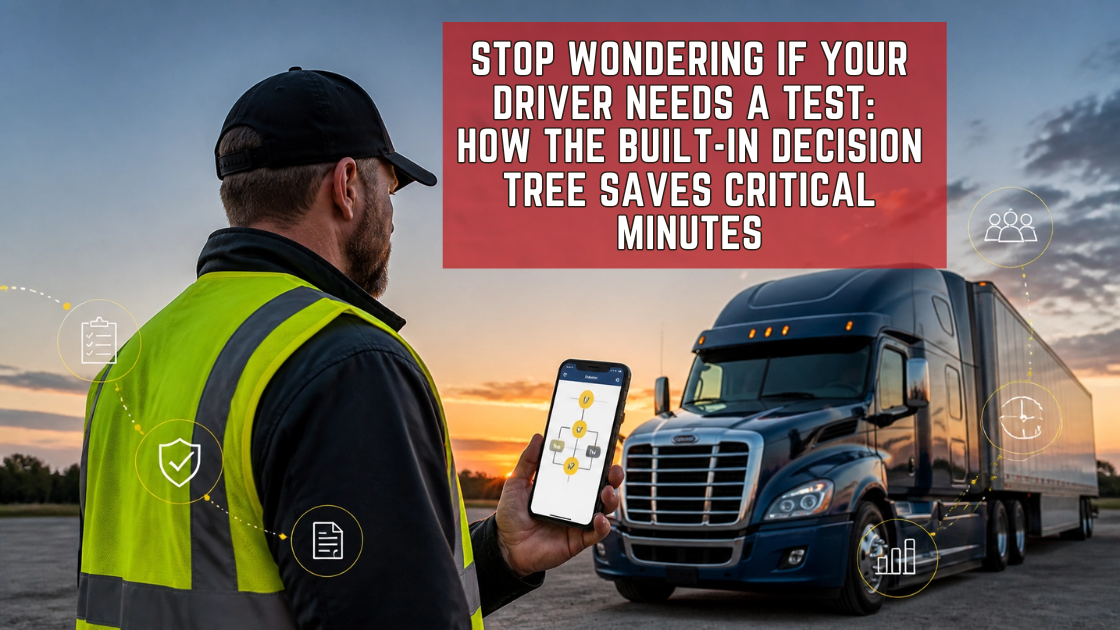
A post-accident testing decision often begins under difficult conditions. You may be standing at a roadside scene, coordinating emergency response, waiting for law enforcement, or trying to reach a driver who is hundreds of miles from your office. At the same time, the DOT testing clock is already running, and every minute spent debating the requirements can make timely collection more difficult.
READI Collect helps simplify that first critical question: Does this accident require DOT post-accident drug and alcohol testing? Its patented app includes a built-in decision tree that guides you through the relevant FMCSA criteria, helping you reach an immediate, informed determination and request an onsite collection without unnecessary delay.
WHY THE FIRST DECISION MATTERS
Under 49 CFR § 382.303, DOT post-accident testing is not automatically required after every crash involving a commercial motor vehicle. The regulation focuses on specific circumstances involving a fatality, a citation for a moving traffic violation, immediate medical treatment away from the scene, or disabling damage that requires a vehicle to be towed. Knowing which facts matter allows you to act quickly without treating every incident as a guessing game.
The challenge is that those facts are not always available in one place. A driver may know that a vehicle was damaged but not whether it will be towed, while a safety manager may be waiting for confirmation of a citation or medical treatment. READI Collect’s decision tree organizes those questions in a guided sequence so you can evaluate the incident methodically instead of losing valuable time searching through regulations or calling multiple people for basic direction.
> Quick Tip: Add READI Collect access and post-accident instructions to your driver procedures before an incident occurs. When your team already knows where to go and what information to gather, the first few minutes are much easier to manage.
THE THREE CORE DOT TRIGGERS
The first trigger is a human fatality. If the accident involves the loss of human life, the surviving driver who was performing safety-sensitive functions must be tested, regardless of whether the driver received a citation. This is the most direct branch in the decision tree because the fatality itself activates the testing requirement under the regulation.
For a non-fatal accident, the analysis generally requires two parts: a qualifying citation and one of two additional conditions. The driver must receive a citation within the applicable regulatory timeframe for a moving traffic violation arising from the accident, and the accident must involve either immediate medical treatment away from the scene or a vehicle requiring transportation away from the scene because of disabling damage.
The decision tree helps you review those criteria in plain operational terms:
Was there a human fatality?
Did the driver receive a citation for a moving traffic violation arising from the accident?
Did anyone receive immediate medical treatment away from the scene?
Did any vehicle require towing from the scene because of disabling damage?
Is the driver a DOT-covered employee performing safety-sensitive functions?
HOW READI COLLECT’S DECISION TREE HELPS
READI Collect’s built-in decision tree is designed to reduce the time between an accident report and a testing determination. Instead of requiring a safety manager to interpret a dense regulation while coordinating an active incident, the app presents the relevant questions in a logical order. You can work through the facts, identify whether the DOT criteria appear to be met, and move directly toward the appropriate collection request.
That does not transfer legal responsibility away from the employer. You remain responsible for maintaining a compliant drug and alcohol testing program, applying your company procedures, and making the final determination based on the facts available. The value of the decision tree is that it gives you a practical, consistent tool to support that decision and reduces the risk that confusion or delay will interfere with your response.
The workflow is especially useful for small carriers and fleet managers who may not have a compliance department available around the clock. It can also help larger fleets standardize the initial response across dispatchers, supervisors, and designated employer representatives. When every person follows the same guided process, you are less likely to overlook a qualifying detail or spend critical time debating what to do next.
MINUTES MATTER MORE FOR ALCOHOL TESTING
Once a qualifying accident is identified, the next priority is initiating testing as soon as practicable. DOT rules identify a two-hour period for administering the alcohol test before additional documentation is required to explain the delay, and attempts must cease after eight hours if the test has not been completed. Alcohol testing is especially time-sensitive because alcohol levels can change substantially over a short period.
Drug testing has a longer window, but that does not mean you should wait. A DOT post-accident controlled substances test must be completed as soon as practicable and no later than 32 hours after the accident. A delayed request can still create problems when the driver is remote, the incident occurs overnight, or the nearest testing facility has limited hours.
That is why reducing the decision time is so important. If your team spends 30 or 45 minutes debating whether a test is required, those minutes are no longer available for locating a collector, confirming the driver’s location, and completing the onsite collection. READI Collect lets you move from guided determination to dispatch through a single platform, helping you make the most of the applicable testing windows.
> Quick Tip: Treat the two-hour alcohol target as an operational deadline, not a time cushion. Start the decision process immediately after emergency needs are addressed, and document any circumstances that prevent timely testing.
FROM DECISION TO ONSITE COLLECTION
After you determine that testing is required, READI Collect allows you to request an onsite drug and alcohol collection through its web-based platform or mobile app. The request is sent to a nationwide network of professional collectors, allowing an available collector near the driver’s location to respond. This can be particularly valuable when the driver is at a rural roadside location or an area where a traditional clinic is closed.
Onsite testing eliminates the need to send the driver across town or wait for a fixed facility to open. It also reduces the logistical uncertainty that often follows an accident, when the vehicle may be disabled and the driver may be dealing with law enforcement, medical personnel, or fleet recovery. READI Collect’s stated goal is to connect employers with collectors quickly, including through 24/7/365 service.
The platform also provides visibility while the request is in progress. Depending on the event, your company portal can show status updates, time stamps, precise location information, and other event details that support your compliance records. That real-time information helps you know whether the request has been accepted, whether a collector is traveling to the scene, and where the event stands.
BUILD A FASTER POST-ACCIDENT RESPONSE
Technology works best when it is supported by a clear internal procedure. Before an incident occurs, identify the people authorized to initiate a collection, confirm that drivers and supervisors know how to access READI Collect, and establish how your team will record the accident time, location, citation information, medical treatment, and towing status. Your written policy should also explain how emergency care takes priority and how the driver must remain readily available for testing when medically able.
A practical response checklist may include the following:
Protect life and contact emergency services when necessary.
Record the exact time and location of the accident.
Confirm whether the driver was performing DOT-covered safety-sensitive functions.
Use the READI Collect decision tree to review the testing criteria.
Request alcohol testing as soon as practicable when required.
Request drug testing as soon as practicable and within 32 hours when required.
Keep the driver available for testing unless emergency care or other permitted circumstances prevent it.
Preserve time stamps, communications, and explanations for any delay.
A consistent process gives your team a better chance of meeting DOT requirements while treating the driver fairly and professionally. It also helps you demonstrate that the company took reasonable, timely steps after the incident. READI Collect can support the collection and documentation portion of that process, but it should operate alongside your written policy and broader accident-response plan.
A PRACTICAL TOOL FOR SAFETY MANAGERS
The hardest part of post-accident testing is often not the collection itself. It is making the right determination quickly while managing incomplete information, remote locations, after-hours events, and competing safety priorities. READI Collect’s patented decision-tree technology addresses that early bottleneck by giving you a guided way to review whether the incident meets the key DOT criteria.
You do not have to choose between careful compliance review and a fast response. By using the decision tree immediately, you can reduce unnecessary debate, begin locating a collector sooner, and preserve more of the alcohol and drug testing windows for the collection itself. The platform’s onsite model, real-time status reporting, and geo-fenced event tracking add further visibility when your team needs a clear record of what happened and when.
For transportation companies, that combination of speed and structure can make a meaningful difference after a serious incident. The goal is not simply to complete a test; it is to protect people, follow the rules, support an accountable safety program, and make responsible decisions under pressure.
IN CONCLUSION
When an accident occurs, asking whether testing is required should not consume the time you need to arrange it. The DOT criteria can be summarized around a fatality, or a qualifying citation combined with immediate medical treatment away from the scene or a vehicle tow, but applying those criteria in real time can still be difficult. READI Collect’s built-in decision tree gives you a faster, more consistent way to work through the facts and move toward action.
Remember that the employer remains responsible for its testing program and final compliance decisions. Use the app together with your written policy, trained personnel, emergency procedures, and accurate event documentation. To reduce late-night scrambling and improve your response after an accident, sign up for READI Collect or schedule an onsite collection through the READI Collect platform.
Helpful search terms: DOT post-accident testing decision tree, FMCSA post-accident testing criteria, 49 CFR 382.303, DOT alcohol testing two-hour rule, DOT drug testing 32-hour window, onsite post-accident drug testing, mobile collector dispatch, and real-time testing status reports.