Why Post-Accident Drug Testing Fails (And How Onsite Collectors Fix the 2-Hour Problem)
May 11, 2026 · RC Team
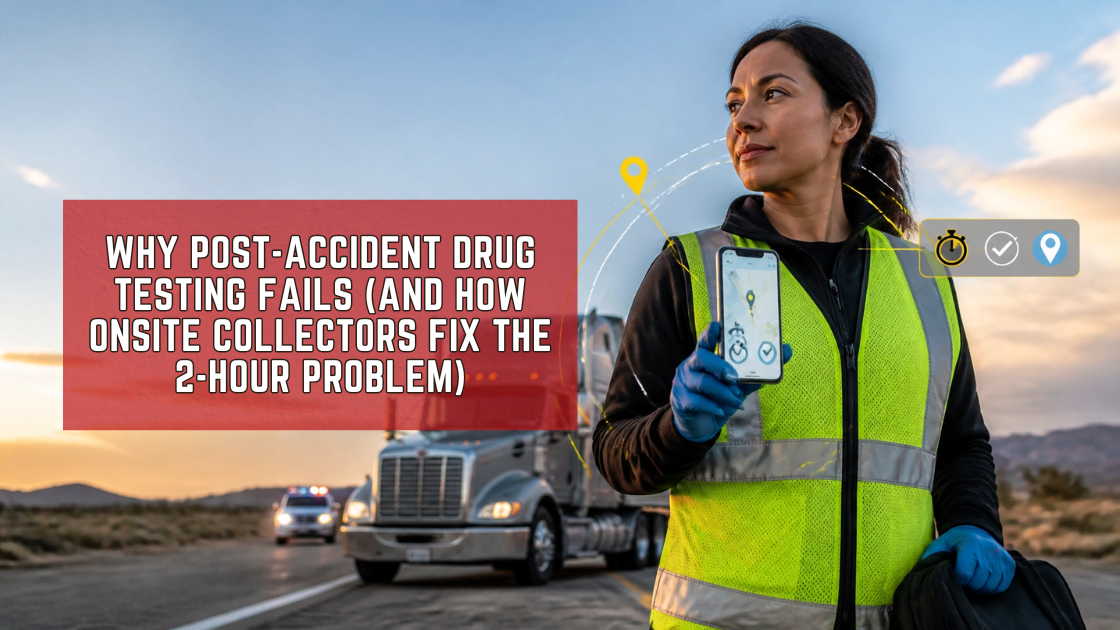
A post-accident event creates immediate safety, medical, law enforcement, and compliance responsibilities. For DOT-regulated employers, the situation becomes even more time-sensitive when a driver may need alcohol and controlled-substances testing under 49 CFR §382.303. The challenge is not usually a lack of concern about compliance; it is that traditional testing logistics often cannot keep pace with the first two hours after an incident.
That is where onsite collection makes a practical difference. READI Collect connects employers with a nationwide network of more than 3,000 certified collectors through a patented mobile application designed for urgent, location-based testing. Instead of asking a driver to leave a scene and find an open clinic, you can request a qualified collector to come to the driver’s location.
WHY POST-ACCIDENT TESTING IS SO DIFFICULT
Post-accident testing usually happens during a period of confusion. A driver may need medical attention, law enforcement may be investigating, the vehicle may be disabled, and the employer may still be determining whether the event meets DOT testing criteria. At the same time, the clock is already moving toward the two-hour alcohol-testing target.
A fixed clinic can introduce several delays, including travel time, wait times, limited operating hours, and uncertainty about whether the facility can perform the specific DOT test required. Those delays become even more serious when the incident occurs at night, on a weekend, in a rural area, or far from the carrier’s normal service locations. A driver who cannot safely or legally leave the scene may have no practical way to reach a clinic quickly.
The problem is therefore operational as much as regulatory. Even a well-managed fleet can miss a testing window if its response plan depends on finding a nearby facility after an accident has already occurred. The most effective plan puts the collection professional in motion as soon as the decision to test has been made.
THE DOT TWO-HOUR ALCOHOL TESTING PROBLEM
Under §382.303, a required post-accident alcohol test must be administered as soon as practicable. The first two hours are the preferred testing window, and if the test is not completed within that period, the employer must prepare and maintain a record explaining why the test was not promptly administered.
The two-hour point is not an automatic permission to stop trying. Employers must continue making reasonable efforts to complete the alcohol test until eight hours have elapsed. If the test is not administered within eight hours, the employer must stop attempting to administer it and document the reasons it was not completed.
Drug testing follows a separate timeline. A required post-accident controlled-substances test must also be conducted as soon as practicable, but attempts generally end after 32 hours if the test has not been administered. You can review the federal requirements in the FMCSA’s post-accident testing guidance and the full regulation linked above.
> Quick Tip: Treat the two-hour alcohol window as an immediate-response target, not a deadline you can safely approach. Build your procedure around contacting a collector during the first few minutes after the incident when it is safe to do so. If the window is missed, document the specific reason and continue following the applicable federal requirements.
WHEN IS A DOT POST-ACCIDENT TEST REQUIRED?
Not every minor crash automatically requires a DOT post-accident test. Under the federal criteria, testing is generally required when the accident involves a human fatality, or when the driver receives a citation for a moving violation and the accident involves qualifying bodily injury or disabling vehicle damage requiring a tow-away.
For an accident involving a fatality, both alcohol and drug testing may be required when the driver was performing safety-sensitive functions. For qualifying injury or tow-away incidents, the citation-based requirements apply separately to alcohol and drug testing, each with its own time considerations.
This determination can be difficult in the field because the facts may change as law enforcement investigates the event. READI Collect’s built-in decision tree helps guide you through the question of whether a DOT driver requires testing, reducing the time spent searching through procedures during a stressful event. The decision tree supports your response process, but your designated employer representative should continue to apply the current DOT rules and obtain professional guidance when the circumstances are unclear.
HOW ONSITE COLLECTORS REMOVE THE BIGGEST DELAYS
Onsite collection changes the starting point for the testing process. Rather than sending a driver away from the incident location, you can request a certified collector to travel to the roadside, terminal, maintenance yard, or another safe location where the driver is available.
READI Collect’s patented app uses Geo Net technology to distribute a request to nearby mobile collectors. Through the company portal or mobile access, you can initiate an on-demand collection within seconds and monitor the event as the request is accepted, dispatched, and completed.
The service is designed for urgent situations and operates 24/7/365. With more than 3,000 collectors across the country, READI Collect helps employers respond even when the nearest traditional clinic is closed or too far away to support the required testing window.
WHAT READI COLLECT GIVES SAFETY MANAGERS
Speed is only one part of a defensible post-accident response. You also need visibility into what happened, when it happened, where it happened, and who handled each step of the collection process.
READI Collect provides tools intended to support that documentation, including:
Real-time status reports showing the progress of a collection event.
Geo-fenced tracking that helps verify the event location and movement of the response.
Time stamps covering request initiation and key interactions through completion.
Company portal access for current events, scheduled collections, and reporting.
Detailed event records that may include location information, scene photos, witness accounts, weather, and road conditions, depending on the event.
24/7 customer service and dispatch support for urgent and after-hours situations.
Audit assistance when an event is reviewed by a DOT representative, insurer, or law enforcement agency.
These tools do not replace your recordkeeping responsibilities, but they can make the record more complete and easier to retrieve. When an incident is later questioned, a clear timeline is far more useful than a collection of disconnected phone calls, handwritten notes, and uncertain recollections.
> Quick Tip: Add onsite collection instructions to your accident-response checklist before you need them. Your procedure should identify who can authorize testing, how to access the READI Collect app or portal, what information to provide about the driver’s location, and who is responsible for documenting delays or exceptions.
A BETTER RESPONSE FOR ROADSIDE AND REMOTE INCIDENTS
A driver may be waiting for law enforcement, dealing with a disabled vehicle, or receiving instructions from an emergency responder. In those circumstances, asking the driver to locate and travel to a clinic can create unnecessary risk and consume valuable time.
Onsite testing allows the response to follow the incident instead of forcing the incident to fit a clinic’s schedule. A certified collector can meet the driver at a safe, authorized location while the carrier’s safety team maintains visibility through the READI Collect platform.
The approach is also useful beyond post-accident testing. Employers can use mobile collection services for reasonable-suspicion testing, pre-employment testing, random programs, and other DOT or non-DOT workplace testing needs. Scheduling routine onsite testing can help establish familiarity with the process before an emergency occurs.
BUILD YOUR POST-ACCIDENT RESPONSE PLAN
A reliable plan should be simple enough to use when the situation is stressful. Start by identifying the decision-makers and making sure your DERs, dispatchers, and managers understand the difference between a DOT testing requirement and an internal company-policy requirement.
Your checklist should include the following actions:
Protect life and address medical emergencies first.
Notify law enforcement and follow scene-safety instructions.
Record the accident time, driver location, and relevant facts.
Determine whether the DOT post-accident testing criteria may apply.
Use the READI Collect decision tree to support the testing determination.
Request an onsite collector as soon as testing is required or authorized.
Monitor the request through real-time status updates.
Preserve required documentation, including explanations for delays.
Follow your drug and alcohol policy for notifications, records, and follow-up.
It is also important to train personnel before an incident occurs. A short tabletop exercise can reveal whether employees know who has authority to request testing, whether everyone can access the portal, and whether location information can be communicated accurately from a roadside scene.
USEFUL SEARCH TERMS FOR POST-ACCIDENT COMPLIANCE
When reviewing your procedures or researching additional guidance, these search terms can help you find relevant resources:
DOT post-accident alcohol testing two-hour rule
49 CFR 382.303 post-accident testing
FMCSA post-accident drug testing 32 hours
DOT alcohol testing eight-hour limit
mobile onsite DOT drug testing
roadside post-accident specimen collection
DOT decision tree post-accident testing
employer documentation missed post-accident test
certified mobile drug and alcohol collector
Always confirm that the information you use reflects the current federal rules and your company’s written testing program. Regulations, agency guidance, and workplace circumstances can change, so your compliance process should be reviewed regularly.
IN CONCLUSION: MAKE EVERY MINUTE COUNT
Post-accident testing fails most often when the response depends on conditions you cannot control. A clinic may be closed, the driver may be unable to leave the scene, the location may be remote, or the waiting room may consume the available time. By the time a fleet manager finds a workable option, the preferred two-hour alcohol-testing window may already be gone.
READI Collect gives you a more practical alternative: a patented app, a nationwide network of more than 3,000 certified collectors, real-time status visibility, geo-fenced event tracking, and support for audit documentation. If you want a faster way to handle roadside, remote, or after-hours collections, visit READI Collect to sign up or schedule onsite drug and alcohol testing.